
Stop Writing. Start Chopping!
- Lake Eerie Books team

- Feb 27, 2024
- 3 min read
Reflections on word count and self-discipline
So you’ve finally written the novel that was in your head all those years.
When you finish the last scene, you glance down at the word count bar: 140,000.
The number seems big, but it’s a big story. The kind of story readers love, with lots of characters and a complex plot with twists and turns and profound things to say. Or maybe it’s a fantasy novel with serious world-building, or a historical novel with lush and detailed settings.
Wasn’t War and Peace over half a million words, anyway? You take solace in that, although it’s an old book and anyway, you know you shouldn’t be comparing yourself to Tolstoy. Still, what about Diana Gabaldon’s Outlander (305,000) or Neil Gaiman’s American Gods (183,222)? Those writers aren’t Tolstoy. They’re mere mortals, like you.
You send out twenty query letters. You know it can take a while to hear back, but you’re hopeful that at least one agent will find your premise intriguing, read the measly ten pages she allowed you to send her, and give you a call. And you wait.
And wait.
Three months later, you’re still waiting.
It’s time for the cold, hard truth. With new authors, most literary agents will only consider novels within a narrow word count range. In most genres, that means 80,000 to 100,000 words, although fantasy, historical, and young adult are different. Generally, anything under 60,000 words or over 120,000 is dead in the water.
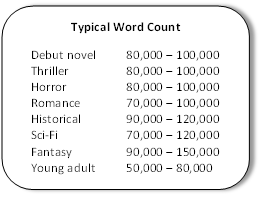
This can be very frustrating for an author with a 140,000-word story to tell, and panic inducing for an author who’s already written one, because the truth is that it will be nearly impossible to find someone to represent and publish that book. Truth is, that masterpiece is headed to Kindle Direct Publishing.
But why is it like this? What’s so magical about the 100,000-word cutoff, and why won’t your manuscript get a fair hearing at 140,000?
A few reasons:
Publishing a book costs money, and publishing a thick book costs more money. A thick book uses more paper and takes up more space in a shipping box. Publishers do not want the extra expense when taking a chance on a new, unproven author.
Reading tastes and habits have changed over the years. People used to buy massive tomes like James Clavell’s Shogun (428,000 words) and curl up in front of the fireplace for the weekend. Today’s smartphone-addicted readers are used to Twitter-sized chunks of content, so the market has shifted to shorter, snappier books. According to Kindlepreneur.com, the vast majority of bestselling books—across most genres, with few exceptions—are between 89,000 and 99,000 words. It’s a brave new world, and everyone in the publishing business has had to adjust.
Agents and publishers have a good understanding of narrative structure. They know that a tight, market-ready, well-editing book usually requires 80,000 to 100,000 words. When they see a much longer manuscript, they assume the author suffers from new-author-itis: excessive descriptions and backstory, lack of discipline in getting to the point and developing plot lines, etc.
Is all this unfair, sometimes? Yes. But agents are not in the fairness business. They are in the business of selling books.
Once you are on the map as an established author, you will have more flexibility. Diana Gabaldon and Neil Gaiman are not worrying about word limits. Once you join the Famous Author club, you too can turn off the word count feature in Microsoft Word. But first you have to join the club.
Bottom line: if your goal is to get representation and a publisher, you should stick to industry standards. At 90,000 words, your manuscript will not be rejected for length.
A few published books from now, you may be free to write the next Animal Farm (29,966 words) or The Stand (471,485). For now, follow the rules if your goal is to publish through traditional channels. Let us know about your experiences with publishers and agents in the comments!


